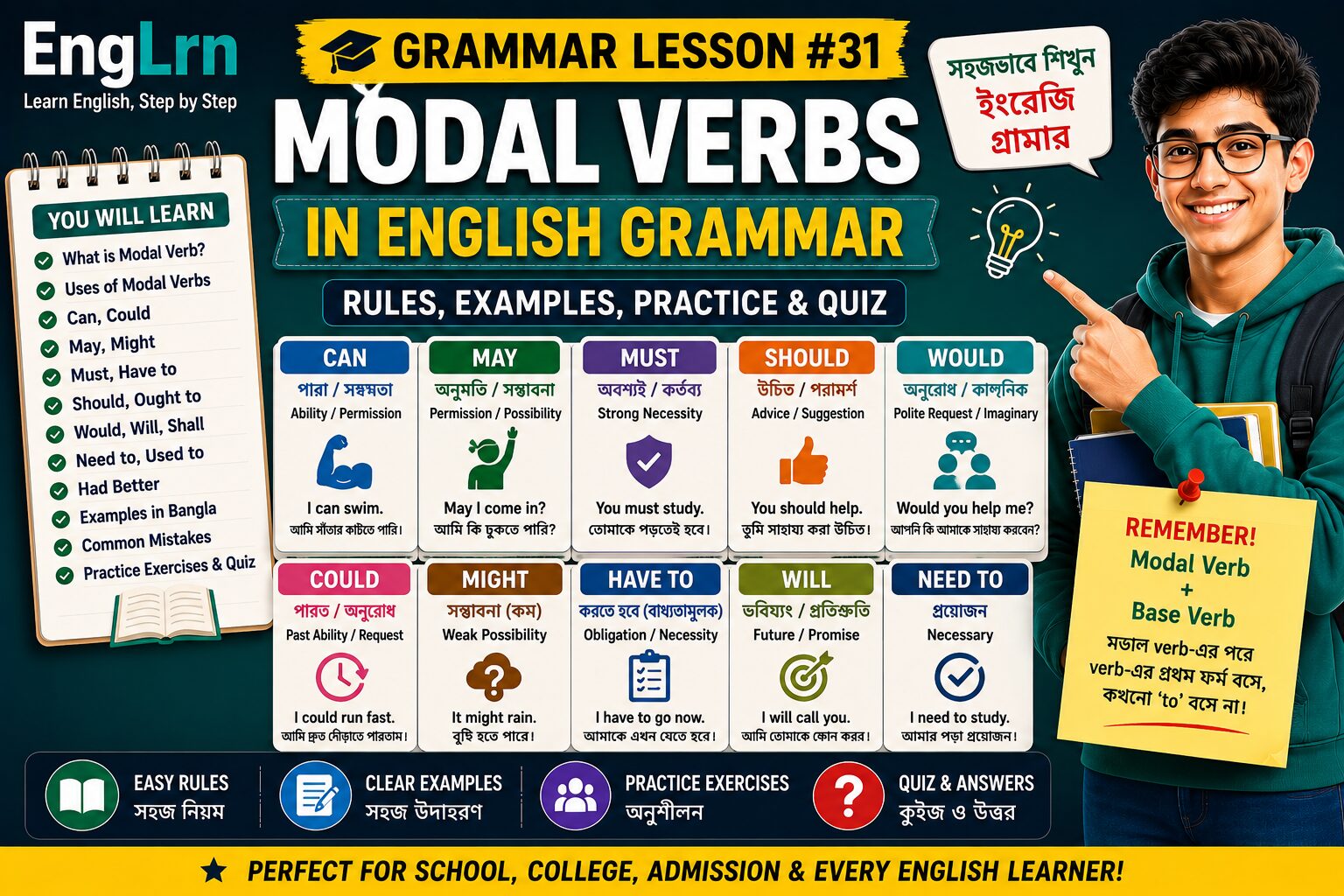
Modal Verbs in English Grammar with Bangla Examples
Modal Verbs in English Grammar
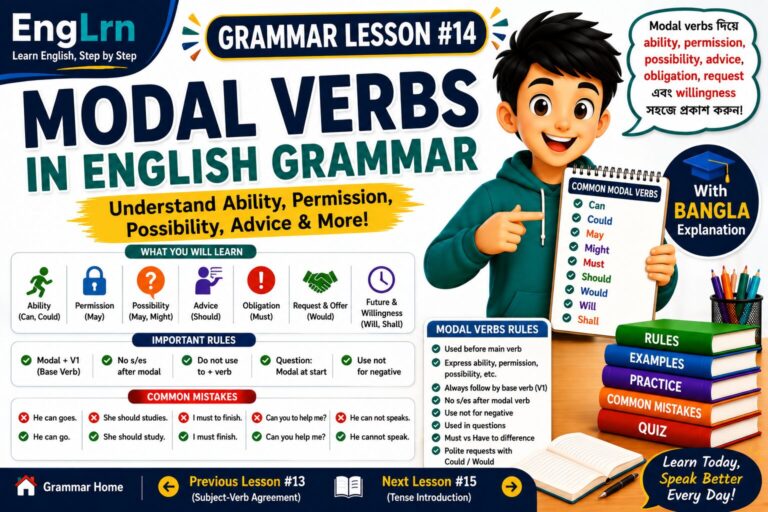
Modal Verbs English Grammar-এর একটি গুরুত্বপূর্ণ topic। Modal verbs দিয়ে ability, permission, possibility, advice, necessity, obligation, request এবং offer প্রকাশ করা হয়। এই lesson-এ Bengali learners can, could, may, might, must, should, would, will, shall, have to, need to ইত্যাদি সহজ Bangla explanation, English examples, quiz এবং FAQ সহ শিখবে।
Modal Verb কী?
Modal Verb হলো auxiliary verb বা helping verb-এর একটি বিশেষ ধরনের verb, যা main verb-এর আগে বসে sentence-এর meaning পরিবর্তন করে। Modal verbs দিয়ে ability, permission, possibility, advice, request, offer, necessity এবং obligation বোঝানো হয়।
I can speak English.
আমি ইংরেজি বলতে পারি।
Modal Verb + Base Verb
Example: can go, should study, must work, may come
Common Modal Verbs List
English Grammar-এ সবচেয়ে common modal verbs হলো:
Basic Modals
can, could, may, might, must, should, would, will, shall
Semi-Modals
have to, need to, ought to, used to, had better, be able to
Modal verb-এর পরে main verb সবসময় base form হয়।
Correct: He can speak English.
Wrong: He can speaks English.
Modal Verb-এর Basic Structure
| Sentence Type | Structure | Example |
|---|---|---|
| Positive | Subject + modal + base verb | She can sing. |
| Negative | Subject + modal + not + base verb | She cannot sing. |
| Question | Modal + subject + base verb? | Can she sing? |
Correct: You must go.
Wrong: You must to go.
Can in English Grammar
Can ব্যবহার করা হয় ability, permission এবং possibility বোঝাতে।
Permission = অনুমতি
Possibility = সম্ভাবনা
I can swim.
আমি সাঁতার কাটতে পারি।
Can I come in?
আমি কি ভিতরে আসতে পারি?
It can be dangerous.
এটি বিপজ্জনক হতে পারে।
Could in English Grammar
Could হলো can-এর past form, তবে এটি polite request এবং possibility বোঝাতেও ব্যবহার হয়।
I could run fast when I was young.
আমি ছোটবেলায় দ্রুত দৌড়াতে পারতাম।
Could you help me, please?
আপনি কি দয়া করে আমাকে সাহায্য করতে পারেন?
It could rain tonight.
আজ রাতে বৃষ্টি হতে পারে।
May in English Grammar
May ব্যবহার করা হয় permission এবং possibility বোঝাতে। May সাধারণত can-এর চেয়ে বেশি formal।
May I ask a question?
আমি কি একটি প্রশ্ন করতে পারি?
He may come today.
সে আজ আসতে পারে।
Can = সাধারণ বা informal permission
May = formal permission
Might in English Grammar
Might ব্যবহার করা হয় weak possibility বা কম সম্ভাবনা বোঝাতে।
সে আগামীকাল আসতে পারে।
আমার দেরি হতে পারে।
সে হয়তো উত্তরটি জানে না।
May = possibility একটু বেশি strong
Might = possibility একটু কম strong
Must in English Grammar
Must ব্যবহার করা হয় strong necessity, obligation, rule এবং logical conclusion বোঝাতে।
You must study hard.
তোমাকে মন দিয়ে পড়তেই হবে।
You must wear a seat belt.
তোমাকে seat belt পরতেই হবে।
He worked all day. He must be tired.
সে সারাদিন কাজ করেছে। সে নিশ্চয়ই ক্লান্ত।
You must not smoke here.
এখানে ধূমপান করা যাবে না।
Have To in English Grammar
Have to ব্যবহার করা হয় necessity বা external obligation বোঝাতে। অর্থাৎ, কোনো নিয়ম, পরিস্থিতি বা বাধ্যবাধকতার কারণে কিছু করতে হয়।
আমাকে এখন যেতে হবে।
তাকে আজ কাজটি শেষ করতে হবে।
আমাদের নিয়মগুলো মানতে হবে।
Must = speaker-এর strong feeling বা rule
Have to = outside rule, situation বা necessity
Should in English Grammar
Should ব্যবহার করা হয় advice, suggestion, duty এবং expectation বোঝাতে।
You should practice English every day.
তোমার প্রতিদিন English practice করা উচিত।
We should leave early.
আমাদের আগে বের হওয়া উচিত।
The train should arrive soon.
ট্রেনটি শিগগিরই আসার কথা।
Ought To in English Grammar
Ought to meaning-এর দিক থেকে should-এর মতো। এটি advice, duty বা moral obligation বোঝাতে ব্যবহার হয়।
তোমার বাবা-মাকে সম্মান করা উচিত।
আমাদের গরিব মানুষদের সাহায্য করা উচিত।
Should বেশি common। Ought to একটু formal বা moral sense দেয়।
Would in English Grammar
Would ব্যবহার করা হয় polite request, imaginary situation, past habit এবং conditional sentence-এ।
Would you help me?
আপনি কি আমাকে সাহায্য করবেন?
I would travel if I had money.
আমার টাকা থাকলে আমি ভ্রমণ করতাম।
When I was a child, I would play outside every evening.
ছোটবেলায় আমি প্রতি সন্ধ্যায় বাইরে খেলতাম।
Will in English Grammar
Will ব্যবহার করা হয় future, promise, decision, offer এবং prediction বোঝাতে।
I will call you tomorrow.
আমি তোমাকে আগামীকাল ফোন করব।
I will help you.
আমি তোমাকে সাহায্য করব।
I will carry your bag.
আমি তোমার ব্যাগটি বহন করব।
Shall in English Grammar
Shall modern English-এ খুব বেশি common নয়, তবে suggestion, offer এবং formal future meaning-এ ব্যবহার হয়।
Shall we start?
আমরা কি শুরু করব?
Shall I open the window?
আমি কি জানালাটি খুলব?
Need To in English Grammar
Need to ব্যবহার করা হয় প্রয়োজন বোঝাতে।
আমার English উন্নত করা প্রয়োজন।
তোমাকে আজ form জমা দিতে হবে।
তাকে আরও practice করা প্রয়োজন।
Had Better in English Grammar
Had better ব্যবহার করা হয় strong advice বা warning বোঝাতে। এর meaning “করা ভালো হবে, না হলে সমস্যা হতে পারে”।
তোমার এখন পড়া ভালো হবে।
তার দেরি না করাই ভালো।
Subject + had better + base verb
Correct: You had better go.
Wrong: You had better to go.
Modal Verbs Chart
| Modal Verb | Main Use | Example | Bangla Meaning |
|---|---|---|---|
| Can | Ability / Permission | I can speak English. | আমি ইংরেজি বলতে পারি। |
| Could | Past ability / Polite request | Could you help me? | আপনি কি আমাকে সাহায্য করতে পারেন? |
| May | Permission / Possibility | May I come in? | আমি কি ভিতরে আসতে পারি? |
| Might | Weak possibility | It might rain. | বৃষ্টি হতে পারে। |
| Must | Strong necessity | You must work hard. | তোমাকে কঠোর পরিশ্রম করতেই হবে। |
| Have to | Obligation | I have to go. | আমাকে যেতে হবে। |
| Should | Advice | You should study. | তোমার পড়া উচিত। |
| Would | Polite request / Imaginary | Would you help me? | আপনি কি আমাকে সাহায্য করবেন? |
| Will | Future / Promise | I will call you. | আমি তোমাকে ফোন করব। |
Common Mistakes Bengali Learners Make
Mistake 1: Modal-এর পরে verb+s ব্যবহার করা
Wrong: He can speaks English.
Correct: He can speak English.
Mistake 2: Must-এর পরে to ব্যবহার করা
Wrong: You must to go now.
Correct: You must go now.
Mistake 3: Should-এর পরে to ব্যবহার করা
Wrong: You should to study.
Correct: You should study.
Mistake 4: Have to structure ভুল করা
Wrong: She have to work.
Correct: She has to work.
Modal Verbs in Spoken English
Daily conversation-এ modal verbs খুব বেশি ব্যবহার হয়। নিচের বাক্যগুলো speaking practice-এর জন্য useful।
| English Sentence | Bangla Meaning |
|---|---|
| Can you help me? | তুমি কি আমাকে সাহায্য করতে পারবে? |
| Could you repeat that? | আপনি কি সেটা আবার বলতে পারেন? |
| May I ask something? | আমি কি কিছু জিজ্ঞেস করতে পারি? |
| I might be late. | আমার দেরি হতে পারে। |
| You should take rest. | তোমার বিশ্রাম নেওয়া উচিত। |
| You must be careful. | তোমাকে অবশ্যই সতর্ক থাকতে হবে। |
| I have to leave now. | আমাকে এখন যেতে হবে। |
| Would you like some tea? | আপনি কি চা চান? |
Interactive Quiz: Modal Verbs
প্রতিটি প্রশ্নের উত্তর ভাবুন, তারপর “Show Answer” খুলে উত্তর দেখুন।
1. He can ____ English. ① speaks ② speak
Full sentence: He can speak English.
2. You ____ study hard for the exam. ① should ② should to
Full sentence: You should study hard for the exam.
3. ____ I come in? ① May ② Must
Full sentence: May I come in?
4. She ____ finish the work today. ① has to ② have to
Full sentence: She has to finish the work today.
5. Correct the sentence: He must to go now.
6. “It might rain” এখানে might কী বোঝায়?
7. Could you help me? — এখানে could কেন ব্যবহার হয়েছে?
8. You ____ not smoke here. ① must ② can to
Full sentence: You must not smoke here.
9. Would you like some coffee? — এখানে would কী বোঝায়?
10. You had better ____ now. ① leave ② to leave
Full sentence: You had better leave now.
Quick Revision
Can / Could
Can ability ও permission বোঝায়। Could past ability ও polite request বোঝায়।
May / Might
May permission ও possibility বোঝায়। Might weak possibility বোঝায়।
Must / Have To
Must strong necessity বোঝায়। Have to outside obligation বোঝায়।
Should / Would
Should advice বোঝায়। Would polite request বা imaginary situation বোঝায়।
FAQ: Modal Verbs
Modal Verb কী?
Modal Verb হলো helping verb-এর একটি বিশেষ ধরনের verb, যা main verb-এর আগে বসে ability, permission, possibility, advice, request, necessity বা obligation বোঝায়।
Modal verb-এর পরে কোন form বসে?
Modal verb-এর পরে main verb-এর base form বসে। যেমন: can go, should study, must work।
Can এবং could-এর মধ্যে পার্থক্য কী?
Can বর্তমান ability বা permission বোঝায়। Could past ability, polite request বা possibility বোঝাতে ব্যবহার হয়।
May এবং might-এর মধ্যে পার্থক্য কী?
May permission বা stronger possibility বোঝায়। Might কম সম্ভাবনা বা weak possibility বোঝায়।
Must এবং have to-এর মধ্যে পার্থক্য কী?
Must speaker-এর strong necessity বা rule বোঝায়। Have to সাধারণত outside rule, situation বা obligation বোঝায়।
Should-এর পরে কি to বসে?
না। Should-এর পরে base verb বসে। Correct: You should study. Wrong: You should to study.
Final Words
Modal Verbs ভালোভাবে শিখলে English speaking এবং writing অনেক natural হয়। Can, could, may, might, must, should, would, will, have to এবং need to প্রতিদিনের English conversation-এ খুব বেশি ব্যবহার হয়। তাই প্রতিটি modal verb-এর meaning ও structure আলাদা করে practice করা জরুরি।
Previous lesson পড়ুন: Conditional Sentences in English Grammar
Next lesson পড়ুন: Gerund and Infinitive in English Grammar