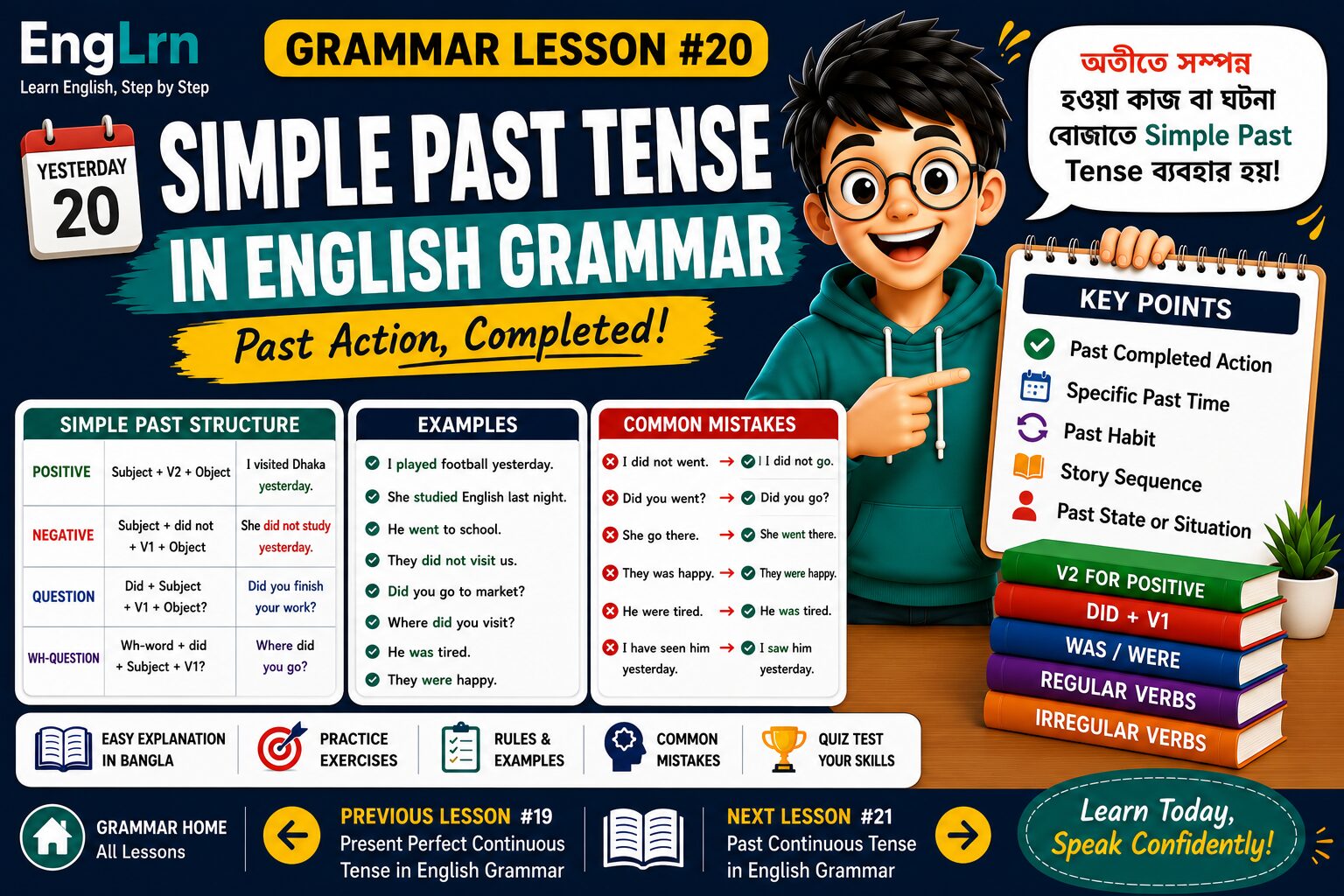
Simple Past Tense in English Grammar
Simple Past Tense in English Grammar
Simple Past Tense হলো এমন tense যা অতীতে সম্পন্ন হওয়া কোনো কাজ, ঘটনা, অভ্যাস, past situation বা story sequence বোঝাতে ব্যবহৃত হয়। Bengali learnersদের জন্য এই tense খুব গুরুত্বপূর্ণ, কারণ daily conversation, storytelling, writing এবং translation-এ “I went”, “She studied”, “They played”, “We visited”—এই ধরনের sentence খুব বেশি লাগে। এই lesson-এ আপনি simple past tense meaning, uses, structure, V2 rules, did negative-question rules, regular and irregular verbs, was/were rules, common mistakes, practice এবং quiz সহজভাবে শিখবেন।
এই Lesson-এ যা শিখবেন
Grammar Series Navigation
এই lessonটি previous lesson, next lesson এবং main Grammar homepage-এর সাথে connected করা হলো।
Simple Past Tense কী?
Simple Past Tense is used to describe an action, event, or situation that was completed in the past.
Previous Lesson-এর সাথে Connection
Lesson #19-এ আপনি Present Perfect Continuous Tense শিখেছেন, যা past থেকে present পর্যন্ত চলমান action বোঝায়। Simple Past Tense তার থেকে আলাদা, কারণ এটি অতীতে শুরু ও শেষ হওয়া completed action বোঝায়।
Simple Past Tense সাধারণত yesterday, last night, last week, ago, in 2020, once, then—এই ধরনের past time expression-এর সাথে ব্যবহৃত হয়। Positive sentence-এ main verb-এর V2 form ব্যবহার হয়।
She studied English yesterday.
They played football yesterday.
He went to school.
এখানে visited, studied, played, এবং went simple past tense-এর verb form.
Uses of Simple Past Tense
নিচের card-গুলোতে click করলে simple past tense-এর use সহজভাবে দেখাবে।
Completed Past Action
Yesterday, last night, ago.
Past Time Mentioned
Last week, in 2020, yesterday.
Past Habit
When I was young.
Story Sequence
First, then, after that.
Past State
Was, were.
Specific Past Experience
Last month, in 2023.
Simple Past Tense Structure
Positive, negative এবং question structure ভালোভাবে বুঝুন।
| Sentence Type | Structure | Example | Bangla Meaning |
|---|---|---|---|
| Positive | Subject + V2 + Object | I visited Dhaka yesterday. | আমি গতকাল ঢাকা গিয়েছিলাম। |
| Negative | Subject + did not + V1 + Object | She did not study yesterday. | সে গতকাল পড়েনি। |
| Question | Did + Subject + V1 + Object? | Did you finish your work? | তুমি কি তোমার কাজ শেষ করেছিলে? |
| Wh-Question | Wh-word + did + Subject + V1? | Where did you go? | তুমি কোথায় গিয়েছিলে? |
| Be Verb Positive | Subject + was/were + Complement | He was tired. They were happy. | সে ক্লান্ত ছিল। তারা খুশি ছিল। |
Very Important Rule
Did ব্যবহার করলে main verb সবসময় V1/base form হয়। Correct: I did not go. / Did you go? Wrong: I did not went. / Did you went?
Simple Past Tense Rules
Simple past tense ঠিকভাবে ব্যবহার করতে V2, did, was/were এবং past time expressions clear করতে হবে।
Basic Rule
Simple past tense-এর positive sentence-এ main verb-এর V2 form ব্যবহার হয়।
She studied English.
He went home.
Did + V1 Rule
Negative এবং question sentence-এ did ব্যবহার করলে main verb V1/base form হবে।
She did not study English.
Did he go home?
Where did you go?
Was / Were Rule
Past be verb হিসেবে I/he/she/it/singular subject-এর সাথে was এবং you/we/they/plural subject-এর সাথে were ব্যবহার হয়।
He was tired.
They were happy.
We were ready.
Regular Verbs
Regular verbs-এর past form করতে সাধারণত verb-এর শেষে -ed বা -d যোগ হয়।
visit → visited
work → worked
like → liked
Irregular Verbs
Irregular verbs-এর past form আলাদা হয়, তাই এগুলো আলাদাভাবে practice করতে হয়।
eat → ate
see → saw
buy → bought
write → wrote
Past Simple vs Present Perfect
Simple past নির্দিষ্ট past time-এর completed action বোঝায়। Present perfect present result বা experience বোঝায়।
I have seen him before. = life experience
She went to Dhaka last week. = past simple
She has gone to Dhaka. = present result, she is not here now
Common V2 Forms for Simple Past
Simple past tense শেখার জন্য V2 form জানা খুব জরুরি।
| V1 | V2 | Type | Simple Past Example |
|---|---|---|---|
| play | played | Regular | They played football. |
| study | studied | Regular | She studied English. |
| visit | visited | Regular | We visited Sylhet. |
| go | went | Irregular | He went to school. |
| eat | ate | Irregular | I ate rice. |
| see | saw | Irregular | She saw a bird. |
| buy | bought | Irregular | He bought a phone. |
| write | wrote | Irregular | They wrote a letter. |
Bengali Learnersদের Common Simple Past Mistakes
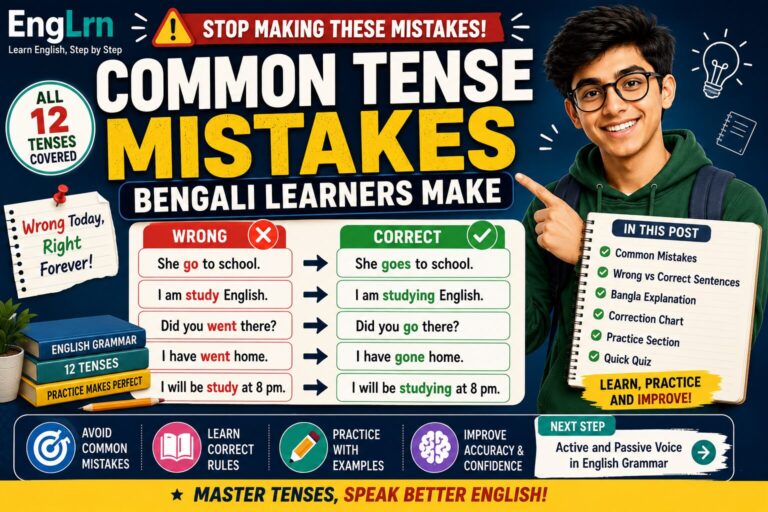
Simple past tense-এ learnersরা did + V1, irregular verb এবং was/were নিয়ে বেশি ভুল করে।
I did not went there. ❌
I did not go there. ✅
Did not-এর পরে main verb V1/base form হয়।
Did you went to school? ❌
Did you go to school? ✅
Question-এ did থাকলে main verb V1 হবে।
She go to Dhaka yesterday. ❌
She went to Dhaka yesterday. ✅
Positive simple past sentence-এ V2 ব্যবহার হয়।
They was happy. ❌
They were happy. ✅
They-এর সাথে were ব্যবহার হয়।
He were tired. ❌
He was tired. ✅
He-এর সাথে was ব্যবহার হয়।
I have seen him yesterday. ❌
I saw him yesterday. ✅
Yesterday থাকলে সাধারণত simple past tense ব্যবহার হয়।
Simple Past Tense Practice
নিচের exercises করে simple past tense practice করুন।
A. Choose the Correct Form
B. Make Negative and Question
C. Quick Quiz
This Lesson Belongs to These Grammar Topics
Main Grammar homepage-এর card/topic structure-এর সাথে এই lesson connect করা হলো।
Tense
এই lesson tense category-এর detailed lesson.
Simple Past
Past completed action বোঝাতে ব্যবহৃত হয়।
Verb Forms
Positive sentence-এ V2 এবং did-এর পরে V1 লাগে।
Speaking Practice
Past story, experience এবং event বলতে simple past tense দরকার।
EngLrn Grammar Lesson Sequence
এই lessonটি Grammar Series-এর বিংশ lesson হিসেবে tracked করা হলো।
Lesson Complete?
এই lesson complete হলে Grammar Lesson #21: Past Continuous Tense in English Grammar পড়ুন।
Simple Past Tense নিয়ে সাধারণ প্রশ্ন
Beginner learnersদের common questions-এর সহজ উত্তর।
Simple Past Tense কী?
Simple Past Tense এমন একটি tense যা অতীতে সম্পন্ন হওয়া action, event, habit, situation বা story sequence বোঝাতে ব্যবহৃত হয়।
Simple Past Tense-এর structure কী?
Positive structure হলো Subject + V2. Negative structure হলো Subject + did not + V1. Question structure হলো Did + Subject + V1?
Did-এর পরে V2 হবে নাকি V1?
Did-এর পরে সবসময় V1/base form হবে। Correct: Did you go? / I did not go. Wrong: Did you went? / I did not went.
Was এবং were কখন ব্যবহার হয়?
I, he, she, it এবং singular subject-এর সাথে was; you, we, they এবং plural subject-এর সাথে were ব্যবহার হয়।
এই lesson-এর পর কোন lesson পড়ব?
এই lesson-এর পর Past Continuous Tense in English Grammar পড়া উচিত, কারণ সেখানে অতীতে কোনো সময় চলমান action শেখানো হবে।
Simple Past Tense in English Grammar for Bengali Learners
এই lesson-এ Bengali learnersদের জন্য Simple Past Tense in English Grammar সহজভাবে ব্যাখ্যা করা হয়েছে। Simple past tense অতীতে সম্পন্ন action, past event, past habit, past situation এবং storytelling বোঝাতে ব্যবহৃত হয়।
V2 rules, did + V1 negative and question structure, regular and irregular verbs, was/were rules, past time expressions এবং common mistakes শেখার মাধ্যমে learners English speaking, writing এবং grammar accuracy improve করতে পারবে।