Transformation of Sentences in English Grammar
Transformation of Sentences in English Grammar
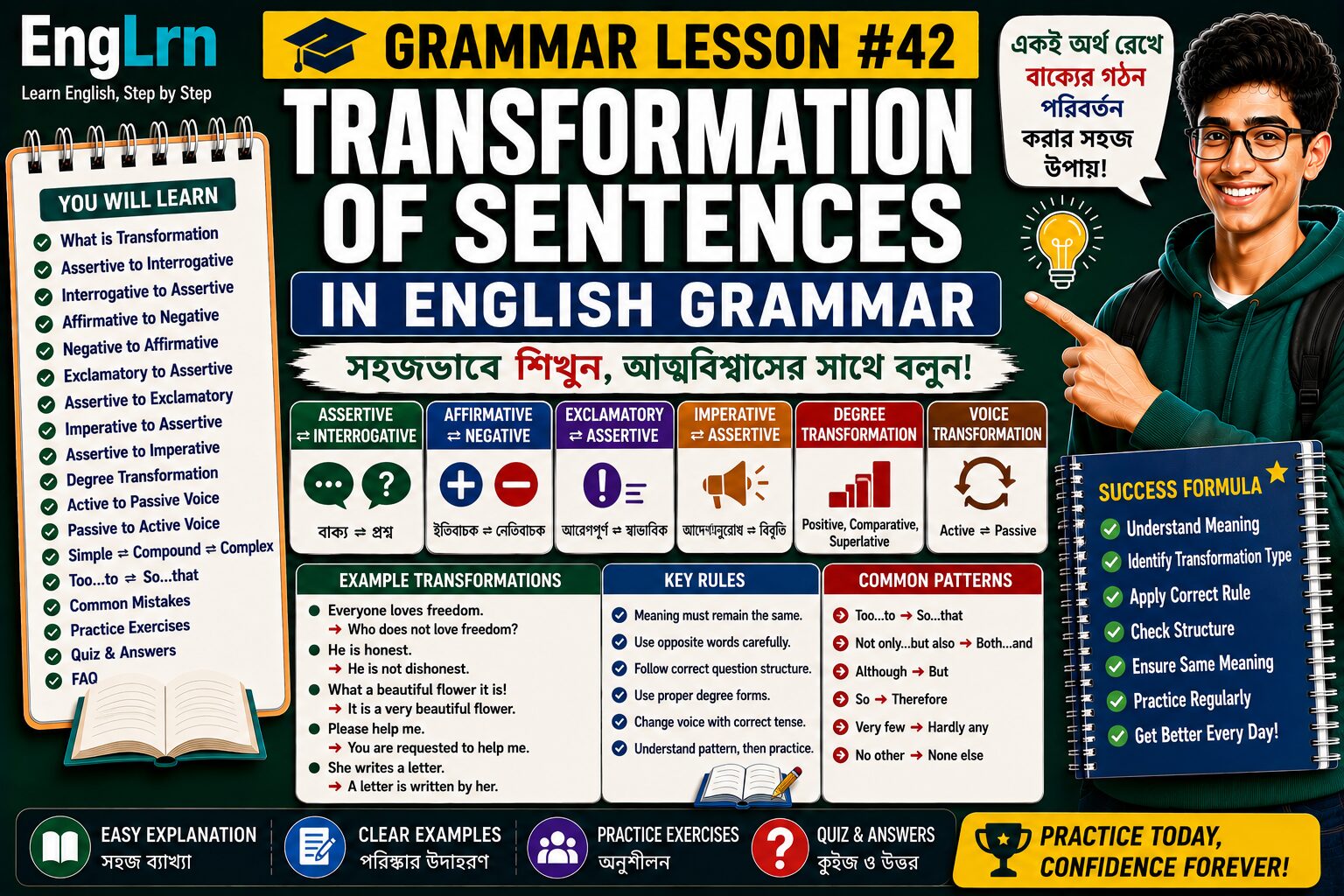
Transformation of Sentences English Grammar-এর একটি গুরুত্বপূর্ণ topic। একই meaning রেখে sentence-এর form বা structure পরিবর্তন করাকে sentence transformation বলে। এই lesson-এ Bengali learners assertive, interrogative, negative, exclamatory, imperative, degree, voice এবং simple-compound-complex transformation সহজ Bangla explanation, examples, quiz এবং FAQ সহ শিখবে।
Transformation of Sentences কী?
Transformation of Sentences হলো sentence-এর meaning একই রেখে sentence-এর structure বা form পরিবর্তন করা। অর্থাৎ, sentence-এর ভাব বা অর্থ একই থাকবে, কিন্তু sentence-এর ধরন বা গঠন বদলে যাবে।
He is very honest.
He is not dishonest.
এখানে দুইটি sentence-এর structure আলাদা, কিন্তু meaning প্রায় একই।
Transformation = Meaning same, structure different.
Why Sentence Transformation is Important
Sentence transformation exam grammar, writing, spoken English এবং sentence variety তৈরি করার জন্য খুব useful।
Exam Grammar
School, college ও admission grammar question-এ transformation খুব common।
Writing Skill
একই meaning বিভিন্নভাবে লিখতে পারলে writing সুন্দর হয়।
Sentence Variety
একই ধরনের sentence বারবার না লিখে variety আনা যায়।
Grammar Control
Sentence structure ভালোভাবে বুঝতে transformation সাহায্য করে।
Main Types of Sentence Transformation
English Grammar-এ transformation বিভিন্নভাবে করা যায়। এই lesson-এ আমরা সবচেয়ে important types শিখব।
Assertive ⇄ Interrogative
Statement থেকে question বা question থেকে statement করা।
Affirmative ⇄ Negative
Positive sentence থেকে negative sentence করা।
Exclamatory ⇄ Assertive
Emotion sentence থেকে normal statement করা।
Imperative ⇄ Assertive
Command/request sentence থেকে statement করা।
Degree Transformation
Positive, comparative, superlative degree পরিবর্তন করা।
Voice Transformation
Active voice থেকে passive voice বা passive থেকে active করা।
Assertive Sentence to Interrogative Sentence
Assertive sentence হলো normal statement। Interrogative sentence হলো question sentence। অনেক সময় meaning same রেখে assertive sentence-কে interrogative করা যায়।
Assertive sentence negative হলে interrogative sentence positive হতে পারে।
Interrogative: Who does not love freedom?
Bangla: স্বাধীনতা কে না ভালোবাসে?
Interrogative: Who can deny this truth?
Bangla: এই সত্য কে অস্বীকার করতে পারে?
Transformation করার সময় meaning যেন change না হয়।
Interrogative Sentence to Assertive Sentence
Interrogative sentence বা question sentence-কে normal statement বা assertive sentence-এ পরিবর্তন করা যায়।
Assertive: Everyone knows this.
Bangla: সবাই এটি জানে।
Assertive: He is a great man.
Bangla: তিনি একজন মহান মানুষ।
Assertive: Nobody can forget his kindness.
Bangla: কেউ তার দয়া ভুলতে পারে না।
Affirmative Sentence to Negative Sentence
Affirmative sentence হলো positive sentence। Meaning same রেখে negative sentence করতে opposite word বা negative expression ব্যবহার করা হয়।
Negative: He is not dishonest.
Bangla: সে অসৎ নয়।
Negative: She is not unwise.
Bangla: সে অবিবেচক নয়।
Negative: Never tell a lie.
Bangla: কখনো মিথ্যা বলো না।
Opposite word ব্যবহার করলে affirmative থেকে negative করা সহজ হয়। honest → dishonest, wise → unwise, possible → impossible.
Negative Sentence to Affirmative Sentence
Negative sentence-কে affirmative sentence করতে negative word বাদ দিয়ে opposite word বা positive structure ব্যবহার করতে হয়।
Affirmative: He is honest.
Affirmative: She is happy.
Affirmative: Everybody likes kindness.
শুধু not বাদ দিলে meaning অনেক সময় change হয়ে যায়। Opposite word ঠিকভাবে ব্যবহার করতে হবে।
Exclamatory Sentence to Assertive Sentence
Exclamatory sentence emotion, surprise, joy, sorrow বা wonder প্রকাশ করে। Assertive sentence হলো normal statement।
Assertive: It is a very beautiful flower.
Bangla: এটি একটি খুব সুন্দর ফুল।
Assertive: The bird is very nice.
Bangla: পাখিটি খুব সুন্দর।
Assertive: It is a great pity.
Bangla: এটি অত্যন্ত দুঃখজনক।
Assertive Sentence to Exclamatory Sentence
Assertive sentence-কে exclamatory করতে what বা how ব্যবহার করা যায়।
| Assertive | Exclamatory |
|---|---|
| It is a very beautiful place. | What a beautiful place it is! |
| The flower is very beautiful. | How beautiful the flower is! |
| He is a very honest man. | What an honest man he is! |
| The story is very interesting. | How interesting the story is! |
What + a/an + adjective + noun + subject + verb!
How + adjective/adverb + subject + verb!
Imperative Sentence to Assertive Sentence
Imperative sentence command, request, advice বা prohibition বোঝায়। এটিকে assertive sentence-এ পরিবর্তন করতে “should”, “must”, “are requested to”, “are advised to” ইত্যাদি ব্যবহার করা যায়।
Assertive: You should study regularly.
Bangla: তোমার নিয়মিত পড়া উচিত।
Assertive: You are requested to help me.
Bangla: আপনাকে আমাকে সাহায্য করার জন্য অনুরোধ করা হচ্ছে।
Assertive: You should not make noise.
Bangla: তোমার শব্দ করা উচিত নয়।
Assertive Sentence to Imperative Sentence
Assertive sentence-কে imperative করতে subject “you” বাদ দিয়ে base verb দিয়ে শুরু করা যায়।
Imperative: Be honest.
Imperative: Don’t waste time.
Imperative: Please sit down.
Degree Transformation
Degree transformation-এ positive, comparative এবং superlative degree-এর মধ্যে sentence পরিবর্তন করা হয়, কিন্তু meaning same থাকে।
Comparative: Rahim is taller than any other boy in the class.
Superlative: Rahim is the tallest boy in the class.
Comparative: Dhaka is larger than most other cities in Bangladesh.
Superlative: Dhaka is one of the largest cities in Bangladesh.
Superlative থেকে positive করতে “No other” বা “Very few” structure খুব common।
Active Voice to Passive Voice Transformation
Active voice থেকে passive voice করতে object নতুন subject হয় এবং main verb-এর past participle form ব্যবহৃত হয়।
Passive: Object + be verb + V3 + by + Subject
Passive: A letter is written by Rahim.
Passive: I was helped by her.
Active Passive Voice আগের lesson-এ বিস্তারিত শেখানো হয়েছে। এখানে transformation-এর basic idea দেওয়া হলো।
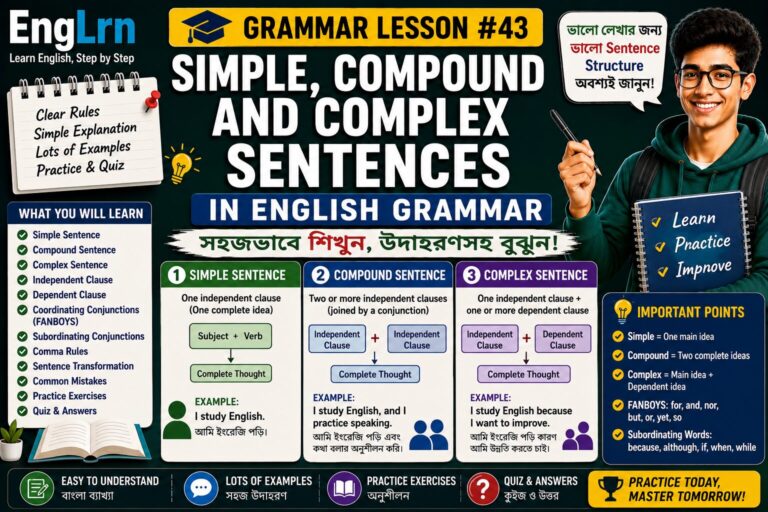
Simple, Compound and Complex Sentence Transformation
একই meaning simple, compound এবং complex sentence দিয়ে প্রকাশ করা যায়। এটি advanced sentence transformation-এর অংশ।
Compound: He is poor, but he is honest.
Complex: Although he is poor, he is honest.
Compound: He worked hard, and he passed the exam.
Complex: He worked hard so that he could pass the exam.
Next lesson-এ Simple, Compound and Complex Sentences বিস্তারিতভাবে শেখানো হবে।
Common Transformation Patterns
| Pattern | Transformation Idea | Example |
|---|---|---|
| Too…to | So…that + cannot | He is too weak to walk. → He is so weak that he cannot walk. |
| Very | What / How exclamatory | It is very nice. → How nice it is! |
| Always | Never + opposite | Always tell the truth. → Never tell a lie. |
| Everyone | Who does not | Everyone loves mother. → Who does not love mother? |
| Nobody | Who can / Who does | Nobody can deny it. → Who can deny it? |
| Positive Degree | Comparative / Superlative | No other boy is as tall as he. → He is the tallest boy. |
Transformation Examples with Bangla Meaning
| Original Sentence | Transformed Sentence | Bangla Meaning |
|---|---|---|
| He is honest. | He is not dishonest. | সে সৎ / সে অসৎ নয়। |
| Everyone respects him. | Who does not respect him? | সবাই তাকে সম্মান করে। |
| What a beautiful flower it is! | It is a very beautiful flower. | এটি খুব সুন্দর ফুল। |
| Do not waste time. | You should not waste time. | তোমার সময় নষ্ট করা উচিত নয়। |
| He is too weak to walk. | He is so weak that he cannot walk. | সে এত দুর্বল যে হাঁটতে পারে না। |
| Rahim is the tallest boy. | No other boy is as tall as Rahim. | রহিম সবচেয়ে লম্বা ছেলে। |
| She writes a letter. | A letter is written by her. | সে একটি চিঠি লেখে। |
| Although he is poor, he is honest. | He is poor, but he is honest. | সে গরিব হলেও সৎ। |
How to Transform Sentences Step by Step
Sentence transformation করার সময় নিচের steps follow করলে ভুল কম হবে।
Step 1
Original sentence-এর meaning ভালোভাবে বুঝুন।
Step 2
কোন type transformation করতে হবে তা identify করুন।
Step 3
Correct structure বা pattern apply করুন।
Step 4
শেষে meaning same আছে কি না check করুন।
Transformation মুখস্থ করার চেয়ে pattern বুঝে practice করা বেশি effective।
Common Mistakes Bengali Learners Make
Mistake 1: Meaning change করে ফেলা
Transformation করলে structure change হবে, meaning নয়।
Mistake 2: Negative word ভুল ব্যবহার
Wrong: He is not honest.
If original meaning is “He is honest”, correct transformation: He is not dishonest.
Mistake 3: Question structure ভুল করা
Wrong: Who not loves freedom?
Correct: Who does not love freedom?
Mistake 4: Exclamatory sentence-এ word order ভুল
Wrong: What beautiful it is!
Correct: How beautiful it is!
Mistake 5: Degree transformation ভুল করা
Wrong: Rahim is taller than all boy.
Correct: Rahim is taller than any other boy.
Mistake 6: Active-passive tense mismatch
Active: She writes a letter.
Passive: A letter is written by her.
Transformation Quick Chart
| Transformation Type | Key Rule | Example |
|---|---|---|
| Assertive to Interrogative | Meaning same রেখে question form | Everyone knows him. → Who does not know him? |
| Affirmative to Negative | Not + opposite word | He is honest. → He is not dishonest. |
| Exclamatory to Assertive | What/How বাদ দিয়ে very/great | How nice it is! → It is very nice. |
| Imperative to Assertive | You should / are requested to | Please sit down. → You are requested to sit down. |
| Degree Transformation | Positive, comparative, superlative change | He is the best. → No one is as good as he. |
| Voice Transformation | Object becomes subject | He writes a letter. → A letter is written by him. |
Interactive Quiz: Transformation of Sentences
প্রতিটি প্রশ্নের উত্তর ভাবুন, তারপর “Show Answer” খুলে উত্তর দেখুন।
1. Transform into negative: He is honest.
2. Transform into interrogative: Everyone loves freedom.
3. Transform into assertive: What a beautiful flower it is!
4. Transform into exclamatory: It is a very nice place.
5. Transform into assertive: Please help me.
6. Transform into imperative: You should be honest.
7. Transform: He is too weak to walk.
8. Transform into passive: She writes a letter.
9. Transform into positive degree: Rahim is the tallest boy in the class.
10. Transform into compound: Although he is poor, he is honest.
Quick Revision
Transformation
Meaning same রেখে sentence structure change করাকে transformation বলে।
Affirmative to Negative
Not + opposite word ব্যবহার করা যায়। Example: honest → not dishonest.
Exclamatory to Assertive
What/How sentence-কে very/great দিয়ে normal statement করা যায়।
Imperative to Assertive
Command/request sentence-এ should, requested to, advised to ব্যবহার হয়।
Degree Transformation
Positive, comparative, superlative degree-এর form change করা হয়।
Voice Transformation
Active থেকে passive করতে object নতুন subject হয়।
Too…to
Too…to → so…that + cannot. Example: too weak to walk.
Main Rule
Transformation করার সময় meaning যেন change না হয়।
FAQ: Transformation of Sentences
Transformation of Sentences কী?
Sentence-এর meaning একই রেখে structure বা form পরিবর্তন করাকে Transformation of Sentences বলে।
Sentence transformation-এ meaning change করা যাবে?
না। Transformation করার সময় sentence-এর meaning same রাখতে হবে। শুধু structure বা form পরিবর্তন হবে।
Affirmative থেকে negative কীভাবে করা যায়?
অনেক ক্ষেত্রে not + opposite word ব্যবহার করে affirmative থেকে negative করা যায়। যেমন: He is honest. → He is not dishonest.
Exclamatory থেকে assertive কীভাবে করা যায়?
What/How structure বাদ দিয়ে very/great/really ব্যবহার করে assertive করা যায়। যেমন: How nice it is! → It is very nice.
Too…to কীভাবে transform করা হয়?
Too…to structure সাধারণত so…that + cannot দিয়ে transform করা হয়। যেমন: He is too weak to walk. → He is so weak that he cannot walk.
Degree transformation কী?
Positive, comparative এবং superlative degree-এর মধ্যে meaning same রেখে sentence পরিবর্তন করাকে degree transformation বলে।
Final Words
Transformation of Sentences ভালোভাবে শিখতে হলে meaning ধরে রেখে structure change করার skill তৈরি করতে হবে। Assertive, interrogative, negative, exclamatory, imperative, degree এবং voice transformation নিয়মিত practice করলে exam grammar ও writing দুটোই শক্তিশালী হবে।
Previous lesson পড়ুন: Imperative Sentences in English Grammar
Next lesson পড়ুন: Simple Compound and Complex Sentences in English Grammar