Question Tags in English Grammar with Bangla Examples
Question Tags in English Grammar
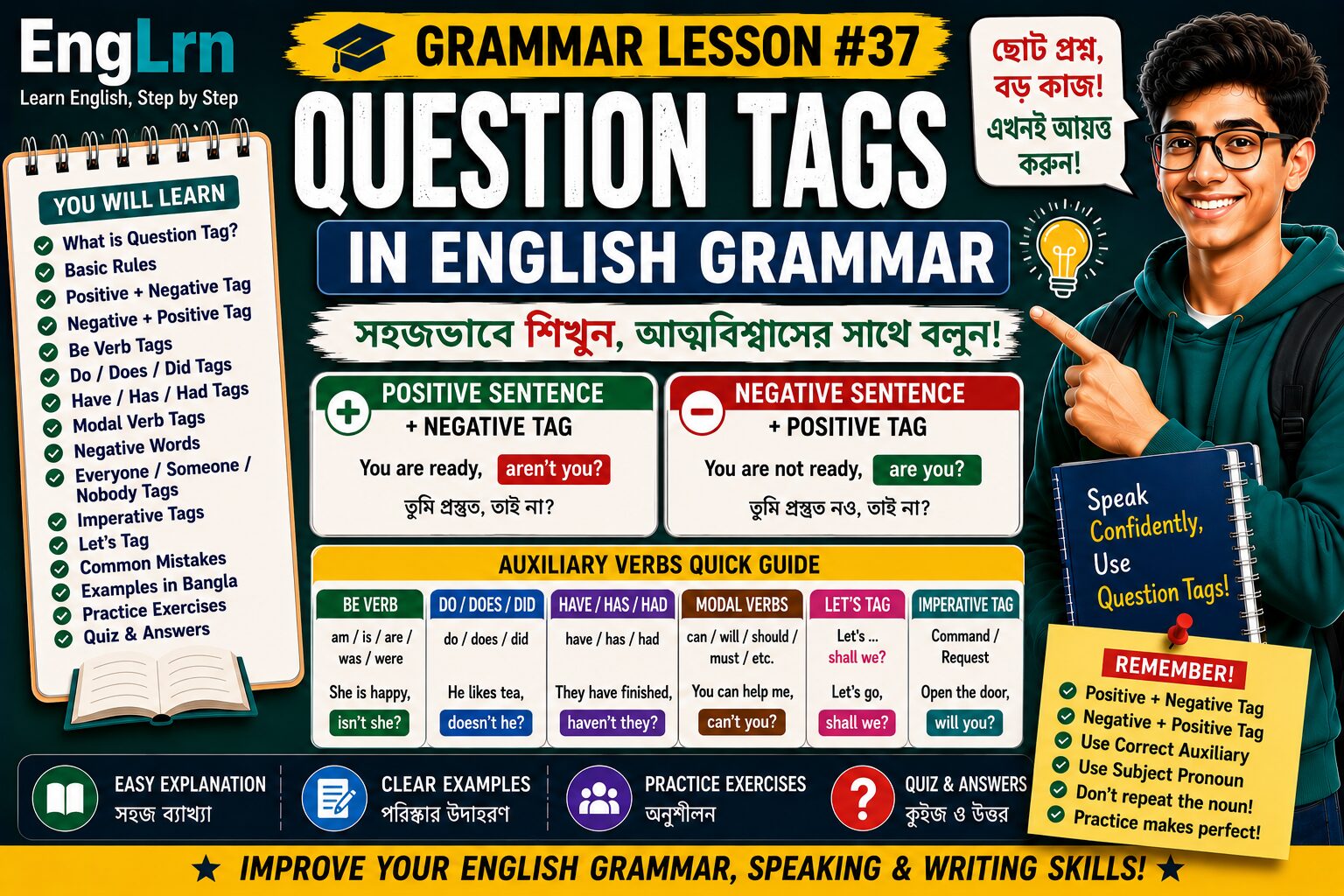
Question Tags English Grammar-এর একটি important topic, বিশেষ করে spoken English-এর জন্য। Question tag ব্যবহার করে আমরা কোনো statement-এর শেষে ছোট question যোগ করি। এই lesson-এ Bengali learners positive sentence, negative tag, negative sentence, positive tag, auxiliary verb, modal verb এবং special question tag rules সহজ Bangla explanation, examples, quiz এবং FAQ সহ শিখবে।
Question Tag কী?
Question Tag হলো sentence-এর শেষে যোগ হওয়া একটি ছোট question। এটি সাধারণত confirmation, agreement বা response পাওয়ার জন্য ব্যবহার করা হয়।
You are a student, aren’t you?
তুমি একজন student, তাই না?
She likes English, doesn’t she?
সে English পছন্দ করে, তাই না?
Question Tag = Statement + small question at the end
Question Tag-এর Basic Rule
Question tag করার সবচেয়ে basic rule হলো: sentence positive হলে tag negative হবে, আর sentence negative হলে tag positive হবে।
Positive Sentence + Negative Tag
Sentence positive হলে tag negative হয়।
Negative Sentence + Positive Tag
Sentence negative হলে tag positive হয়।
Wrong: He is honest, is he?
Correct: He is honest, isn’t he?
Question Tag-এর Structure
They are ready, aren’t they?
You can swim, can’t you?
They are not ready, are they?
You cannot swim, can you?
Question Tag-এ Subject Pronoun ব্যবহার
Question tag-এ main sentence-এর subject সাধারণত pronoun হয়ে যায়।
| Main Subject | Tag Subject | Example |
|---|---|---|
| Rahim | he | Rahim is honest, isn’t he? |
| Rina | she | Rina can sing, can’t she? |
| The book | it | The book is useful, isn’t it? |
| The students | they | The students are ready, aren’t they? |
| You and I | we | You and I are friends, aren’t we? |
Question tag-এ noun repeat করা হয় না। Noun-এর পরিবর্তে pronoun ব্যবহার করা হয়।
Be Verb Question Tags
Main sentence-এ be verb থাকলে tag-এ সেই be verb ব্যবহার হয়।
| Sentence | Question Tag | Full Example |
|---|---|---|
| I am | aren’t I? | I am right, aren’t I? |
| He is | isn’t he? | He is busy, isn’t he? |
| She is not | is she? | She is not ready, is she? |
| They are | aren’t they? | They are students, aren’t they? |
| It was | wasn’t it? | It was easy, wasn’t it? |
| We were not | were we? | We were not late, were we? |
I am-এর question tag সাধারণত aren’t I?
Example: I am right, aren’t I?
Do, Does, Did Question Tags
Main sentence-এ visible auxiliary না থাকলে tense অনুযায়ী do, does বা did ব্যবহার করতে হয়।
Present Simple: I/You/We/They
do / don’t ব্যবহার হয়।
Present Simple: He/She/It
does / doesn’t ব্যবহার হয়।
Past Simple
did / didn’t ব্যবহার হয়।
He works hard, doesn’t he?
She called you, didn’t she?
Have, Has, Had Question Tags
Have/has/had যদি perfect tense-এর helping verb হয়, তাহলে tag-এ have/has/had ব্যবহার হয়।
She has completed her homework, hasn’t she?
They had left early, hadn’t they?
কিন্তু have যদি possession বা “আছে” অর্থে main verb হয়, তাহলে British English-এ have tag এবং American English/common use-এ do/does tag দেখা যায়।
You have a pen, don’t you?
Possession অর্থে have/has থাকলে do/does tag ব্যবহার করা সহজ ও safe।
Modal Verb Question Tags
Sentence-এ modal verb থাকলে question tag-এ একই modal verb ব্যবহার হয়।
| Modal Verb | Example | Tag |
|---|---|---|
| can | You can swim | can’t you? |
| could | He could help us | couldn’t he? |
| will | She will come | won’t she? |
| would | They would agree | wouldn’t they? |
| should | You should study | shouldn’t you? |
| must | We must go | mustn’t we? |
He can speak English, can’t he?
They will join us, won’t they?
Negative Words and Positive Tags
Sentence-এ never, no, nobody, nothing, hardly, scarcely, rarely, seldom ইত্যাদি negative meaning থাকলে tag positive হয়।
Nobody came, did they?
Nothing is impossible, is it?
She hardly speaks, does she?
Sentence দেখতে positive মনে হলেও যদি negative word থাকে, tag positive হবে।
Everyone, Someone, Nobody-এর Question Tags
Everyone, everybody, someone, somebody, no one, nobody ইত্যাদির question tag-এ সাধারণত they ব্যবহার করা হয়।
Somebody called you, didn’t they?
Nobody helped him, did they?
No one knows the answer, do they?
Indefinite pronoun-এর tag-এ modern English-এ singular they ব্যবহার খুব common।
This, That, These, Those-এর Question Tags
This/that-এর tag subject সাধারণত it হয়। These/those-এর tag subject সাধারণত they হয়।
That was a good idea, wasn’t it?
These are your pens, aren’t they?
Those were expensive, weren’t they?
Imperative Sentence Question Tags
Imperative sentence বা command/request sentence-এর question tag সাধারণত will you?, won’t you? বা can you? হতে পারে।
Please help me, will you?
Sit down, won’t you?
Don’t make noise, will you?
Request sentence-এ will you খুব common এবং polite।
Let’s Question Tag
Let’s দিয়ে sentence শুরু হলে question tag সাধারণত shall we? হয়।
Let’s start the class, shall we?
Let’s practice English, shall we?
Wrong: Let’s go, will you?
Correct: Let’s go, shall we?
Question Tags in Spoken English
Spoken English-এ question tags natural conversation তৈরি করতে সাহায্য করে।
| English Sentence | Bangla Meaning |
|---|---|
| You are coming, aren’t you? | তুমি আসছ, তাই না? |
| It is easy, isn’t it? | এটা সহজ, তাই না? |
| She speaks English well, doesn’t she? | সে ভালো English বলে, তাই না? |
| They didn’t call you, did they? | তারা তোমাকে ফোন করেনি, তাই তো? |
| You can help me, can’t you? | তুমি আমাকে সাহায্য করতে পারবে, তাই না? |
| Let’s practice together, shall we? | চলো একসাথে practice করি, কেমন? |
| Don’t be late, will you? | দেরি করো না, ঠিক আছে? |
| Everyone understood the lesson, didn’t they? | সবাই lesson বুঝেছে, তাই না? |
Question Tags Quick Chart
| Sentence | Correct Tag | Full Example |
|---|---|---|
| He is happy | isn’t he? | He is happy, isn’t he? |
| She is not ready | is she? | She is not ready, is she? |
| You like tea | don’t you? | You like tea, don’t you? |
| He likes tea | doesn’t he? | He likes tea, doesn’t he? |
| They went there | didn’t they? | They went there, didn’t they? |
| You can swim | can’t you? | You can swim, can’t you? |
| Let’s go | shall we? | Let’s go, shall we? |
| Everyone is ready | aren’t they? | Everyone is ready, aren’t they? |
Common Mistakes Bengali Learners Make
Mistake 1: Positive sentence-এর সাথে positive tag
Wrong: He is good, is he?
Correct: He is good, isn’t he?
Mistake 2: Main subject repeat করা
Wrong: Rahim is honest, isn’t Rahim?
Correct: Rahim is honest, isn’t he?
Mistake 3: Present simple tag ভুল করা
Wrong: She likes tea, isn’t she?
Correct: She likes tea, doesn’t she?
Mistake 4: Let’s tag ভুল করা
Wrong: Let’s start, will you?
Correct: Let’s start, shall we?
Mistake 5: Never থাকলে negative tag দেওয়া
Wrong: He never lies, doesn’t he?
Correct: He never lies, does he?
Mistake 6: I am-এর tag ভুল করা
Wrong: I am right, amn’t I?
Correct: I am right, aren’t I?
Interactive Quiz: Question Tags
প্রতিটি প্রশ্নের উত্তর ভাবুন, তারপর “Show Answer” খুলে উত্তর দেখুন।
1. He is a student, ____?
Full sentence: He is a student, isn’t he?
2. She likes English, ____?
Full sentence: She likes English, doesn’t she?
3. They went home, ____?
Full sentence: They went home, didn’t they?
4. You can swim, ____?
Full sentence: You can swim, can’t you?
5. She is not ready, ____?
Full sentence: She is not ready, is she?
6. Let’s start, ____?
Full sentence: Let’s start, shall we?
7. I am right, ____?
Full sentence: I am right, aren’t I?
8. Nobody came, ____?
Full sentence: Nobody came, did they?
9. This is your book, ____?
Full sentence: This is your book, isn’t it?
10. Don’t make noise, ____?
Full sentence: Don’t make noise, will you?
Quick Revision
Basic Rule
Positive sentence হলে negative tag। Negative sentence হলে positive tag।
Auxiliary Verb
Sentence-এ auxiliary থাকলে tag-এ সেই auxiliary ব্যবহার হয়।
Do / Does / Did
Visible auxiliary না থাকলে tense অনুযায়ী do, does বা did ব্যবহার হয়।
Let’s Rule
Let’s দিয়ে sentence শুরু হলে tag হয় shall we?
I am Rule
I am-এর question tag সাধারণত aren’t I?
Negative Words
Never, nobody, nothing, hardly থাকলে tag positive হয়।
Everyone Rule
Everyone, someone, nobody-এর tag-এ সাধারণত they ব্যবহার হয়।
Imperative Rule
Command/request sentence-এর tag হিসেবে will you? খুব common।
FAQ: Question Tags in English Grammar
Question Tag কী?
Question Tag হলো sentence-এর শেষে যোগ হওয়া ছোট question, যা confirmation বা response পাওয়ার জন্য ব্যবহার করা হয়। যেমন: You are ready, aren’t you?
Question Tag-এর basic rule কী?
Positive sentence-এর সাথে negative tag এবং negative sentence-এর সাথে positive tag ব্যবহার হয়।
I am-এর question tag কী?
I am-এর question tag সাধারণত aren’t I? যেমন: I am right, aren’t I?
Let’s-এর question tag কী?
Let’s-এর question tag হলো shall we? যেমন: Let’s go, shall we?
Everyone-এর tag-এ কোন pronoun ব্যবহার হয়?
Everyone, someone, nobody ইত্যাদির question tag-এ সাধারণত they ব্যবহার হয়। যেমন: Everyone is ready, aren’t they?
Never থাকলে tag positive হবে নাকি negative?
Never negative meaning দেয়, তাই tag positive হবে। যেমন: He never lies, does he?
Final Words
Question Tags ভালোভাবে শিখতে হলে প্রথমে sentence positive না negative তা বুঝতে হবে। তারপর auxiliary verb, tense এবং subject pronoun ঠিক করতে হবে। Spoken English-এ natural conversation তৈরি করতে question tag খুব useful।
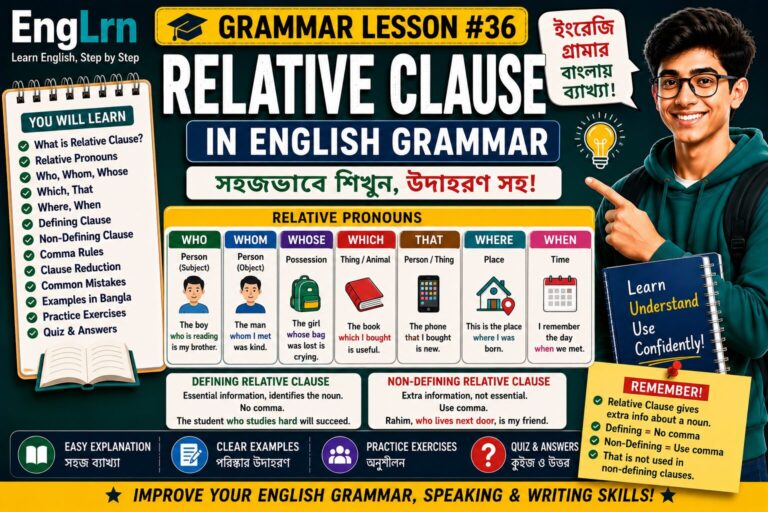
Previous lesson পড়ুন: Relative Clause in English Grammar
Next lesson পড়ুন: WH Questions in English Grammar