Relative Clause in English Grammar with Bangla Examples
Relative Clause in English Grammar
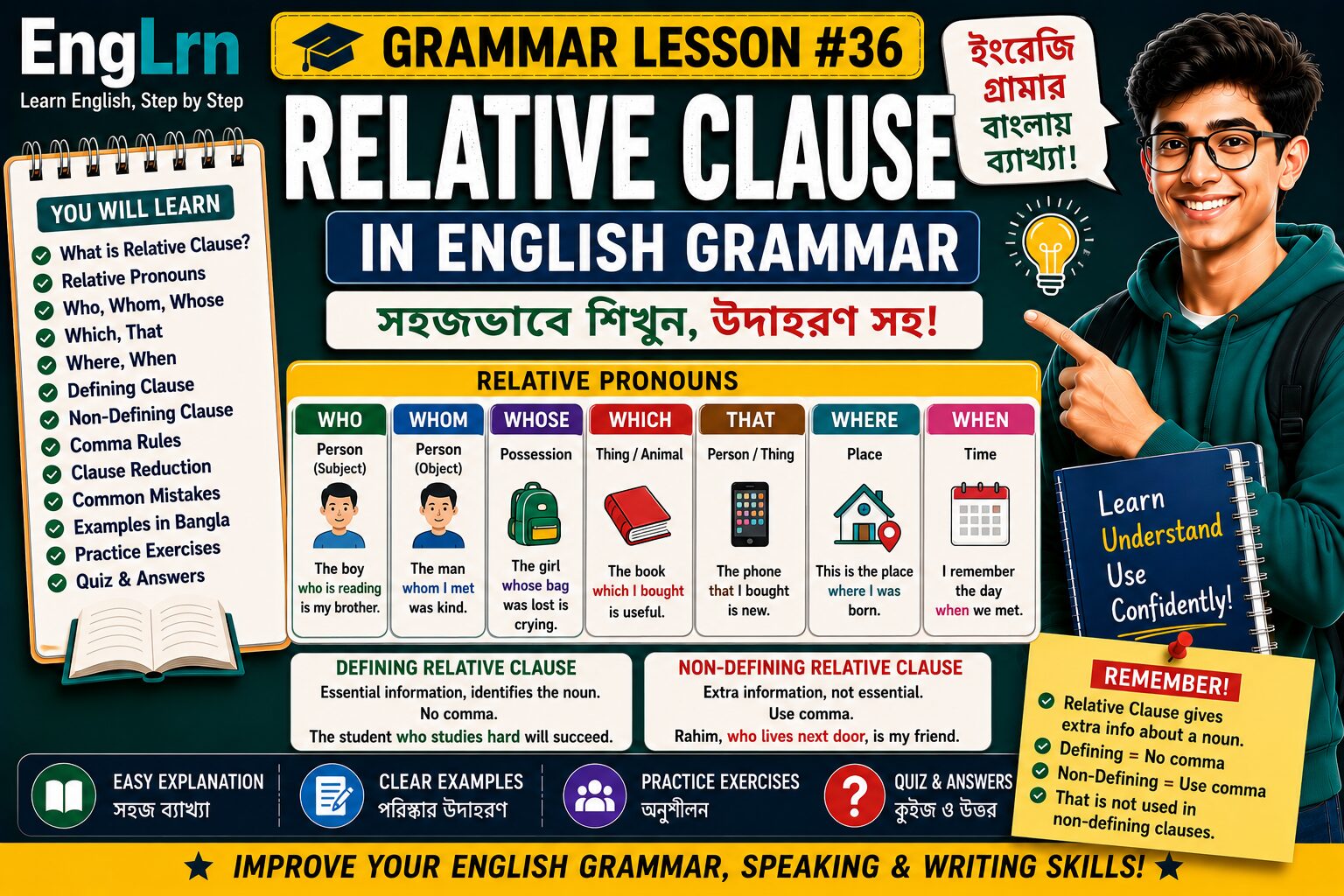
Relative Clause English Grammar-এর একটি গুরুত্বপূর্ণ topic। Relative clause noun বা pronoun সম্পর্কে extra information দেয়। এই lesson-এ Bengali learners who, whom, whose, which, that, where, when, defining relative clause, non-defining relative clause, examples, common mistakes, quiz এবং FAQ সহজ Bangla explanation সহ শিখবে।
Relative Clause কী?
Relative Clause হলো এমন একটি clause, যা কোনো noun বা pronoun সম্পর্কে extra information দেয়। এটি সাধারণত who, whom, whose, which, that, where, when ইত্যাদি relative word দিয়ে শুরু হয়।
The boy who is reading is my brother.
যে ছেলেটি পড়ছে সে আমার ভাই।
এখানে who is reading হলো relative clause, কারণ এটি the boy সম্পর্কে extra information দিচ্ছে।
Relative Clause = Noun/Pronoun সম্পর্কে extra information দেওয়া clause।
Relative Pronoun কী?
Relative Pronoun হলো এমন word, যা relative clause শুরু করে এবং noun/pronoun-এর সাথে clause-কে connect করে।
| Relative Pronoun | Use | Example |
|---|---|---|
| who | Person as subject | The man who called me is my uncle. |
| whom | Person as object | The man whom I met was kind. |
| whose | Possession | The boy whose bag was lost is crying. |
| which | Thing / Animal | The book which I bought is useful. |
| that | Person / Thing | The phone that I bought is new. |
| where | Place | This is the place where I was born. |
| when | Time | I remember the day when we met. |
Relative Clause-এর Basic Structure
Relative clause সাধারণত noun বা pronoun-এর পরে বসে এবং সেই noun/pronoun সম্পর্কে information দেয়।
যে মেয়েটি গান গাইছে সে আমার বোন।
এটি সেই বই যা আমি গতকাল কিনেছি।
Relative clause সাধারণত যাকে describe করে, তার ঠিক পরে বসে।
Who-এর ব্যবহার
Who মানুষ বোঝাতে ব্যবহার হয়, বিশেষ করে যখন relative clause-এর ভিতরে person subject হিসেবে কাজ করে।
যে মানুষটি আমাদের English শেখান তিনি খুব friendly।
যে মেয়েটি prize জিতেছে সে আমার classmate।
আমি এমন একজন মানুষকে চিনি যে তোমাকে সাহায্য করতে পারে।
Whom-এর ব্যবহার
Whom মানুষ বোঝাতে ব্যবহার হয়, যখন person relative clause-এর object হিসেবে কাজ করে। Formal English-এ whom বেশি ব্যবহৃত হয়।
যে মানুষটির সাথে আমি গতকাল দেখা করেছি তিনি একজন ডাক্তার।
যে student-কে teacher প্রশংসা করেছেন সে খুব smart।
Spoken English-এ অনেক সময় whom-এর জায়গায় who ব্যবহার করা হয়। তবে formal grammar-এ object হলে whom ব্যবহার করা ভালো।
Whose-এর ব্যবহার
Whose possession বা মালিকানা বোঝাতে ব্যবহার হয়। এর অর্থ “যার”।
যে ছেলেটির বাবা ডাক্তার সে আমার বন্ধু।
যে মেয়েটির bag হারিয়ে গেছে সে কাঁদছে।
আমি এমন একজন teacher-কে চিনি যার classes খুব helpful।
Which-এর ব্যবহার
Which সাধারণত thing, animal বা idea বোঝাতে ব্যবহার হয়।
যে বইটি আমি গতকাল কিনেছি সেটি খুব useful।
যে movie আমরা দেখেছিলাম সেটি interesting ছিল।
পাশের বাড়িতে থাকা কুকুরটি খুব friendly।
That-এর ব্যবহার
That মানুষ, বস্তু বা প্রাণী—সবকিছুর জন্য ব্যবহার করা যায়। এটি defining relative clause-এ খুব common।
যে ফোনটি আমি কিনেছি সেটি দামি।
যে ব্যক্তি আমাকে সাহায্য করেছিলেন তিনি দয়ালু ছিলেন।
Non-defining relative clause-এ সাধারণত that ব্যবহার করা হয় না। সেখানে who বা which ব্যবহার করা হয়।
Where এবং When-এর ব্যবহার
Where place বোঝাতে এবং when time বোঝাতে ব্যবহার হয়।
Where
Place বা জায়গা বোঝায়।
এটি সেই স্কুল যেখানে আমি পড়েছি।
When
Time বা সময় বোঝায়।
আমি সেই দিনটির কথা মনে করি যখন আমাদের প্রথম দেখা হয়েছিল।
Defining Relative Clause
Defining Relative Clause noun/pronoun-কে identify করতে সাহায্য করে। এটি sentence-এর meaning-এর জন্য essential বা প্রয়োজনীয়।
যে student নিয়মিত পড়ে সে দ্রুত improve করবে।
এখানে who studies regularly অংশটি student-কে identify করছে। তাই এটি defining relative clause।
Defining Relative Clause-এ সাধারণত comma ব্যবহার করা হয় না।
Non-Defining Relative Clause
Non-Defining Relative Clause noun/pronoun সম্পর্কে extra information দেয়, কিন্তু sentence-এর main meaning বুঝতে এটি essential নয়।
রহিম, যে পাশের বাড়িতে থাকে, আমার বন্ধু।
এখানে who lives next door extra information দিচ্ছে। Rahim কে আমরা already identify করেছি।
Non-Defining Relative Clause-এ comma ব্যবহার করা হয়। এখানে সাধারণত that ব্যবহার করা হয় না।
Defining vs Non-Defining Relative Clause
| Point | Defining Relative Clause | Non-Defining Relative Clause |
|---|---|---|
| Purpose | Noun/pronoun identify করে | Extra information দেয় |
| Importance | Sentence meaning-এর জন্য essential | Essential নয় |
| Comma | Comma লাগে না | Comma লাগে |
| That | ব্যবহার করা যায় | ব্যবহার করা যায় না |
| Example | The boy who came here is my friend. | Rahim, who came here yesterday, is my friend. |
Relative Clause Examples with Bangla Meaning
| English Sentence | Relative Clause | Bangla Meaning |
|---|---|---|
| The boy who is standing there is my brother. | who is standing there | যে ছেলেটি সেখানে দাঁড়িয়ে আছে সে আমার ভাই। |
| The book that I bought is useful. | that I bought | যে বইটি আমি কিনেছি সেটি useful। |
| The girl whose bag was lost is crying. | whose bag was lost | যে মেয়েটির bag হারিয়েছে সে কাঁদছে। |
| This is the place where I was born. | where I was born | এটি সেই জায়গা যেখানে আমার জন্ম হয়েছিল। |
| I remember the day when we met. | when we met | আমি সেই দিনটি মনে করি যখন আমাদের দেখা হয়েছিল। |
| My mother, who is very kind, helps everyone. | who is very kind | আমার মা, যিনি খুব দয়ালু, সবাইকে সাহায্য করেন। |
Can We Remove the Relative Pronoun?
অনেক ক্ষেত্রে relative pronoun object হলে সেটি বাদ দেওয়া যায়। কিন্তু subject হলে বাদ দেওয়া যায় না।
The book that I bought is useful.
The book I bought is useful.
দুইটাই correct।
The boy who helped me is kind.
Wrong: The boy helped me is kind.
Relative word-এর পরে যদি subject থাকে, অনেক সময় relative word বাদ দেওয়া যায়।
Relative word নিজেই subject হলে বাদ দেওয়া যায় না।
Relative Clause Reduction: Basic Idea
কিছু relative clause ছোট করে phrase হিসেবে লেখা যায়। এটি advanced writing-এ useful।
The boy who is sitting there is my friend.
Reduced Form:
The boy sitting there is my friend.
The book that was written by him is famous.
Reduced Form:
The book written by him is famous.
Relative clause reduction advanced grammar-এর অংশ। Beginner learners প্রথমে who, whom, whose, which, that, where, when-এর basic use ভালোভাবে practice করুন।
Relative Clause in Spoken English
Spoken English-এ relative clause খুব useful, কারণ এটি sentence-কে natural এবং clear করে।
| English Sentence | Bangla Meaning |
|---|---|
| The person who called you is my friend. | যে ব্যক্তি তোমাকে ফোন করেছে সে আমার বন্ধু। |
| This is the place where we met. | এটি সেই জায়গা যেখানে আমাদের দেখা হয়েছিল। |
| I know someone who can help you. | আমি এমন কাউকে চিনি যে তোমাকে সাহায্য করতে পারে। |
| The phone that I bought is very good. | যে ফোনটি আমি কিনেছি সেটি খুব ভালো। |
| Do you remember the day when we started? | তোমার কি সেই দিনটি মনে আছে যেদিন আমরা শুরু করেছিলাম? |
| The teacher whose class I attend is very helpful. | যে teacher-এর class আমি করি তিনি খুব helpful। |
Common Mistakes Bengali Learners Make
Mistake 1: Relative pronoun বাদ দেওয়া
Wrong: The man helped me is a doctor.
Correct: The man who helped me is a doctor.
Mistake 2: Person-এর জন্য which ব্যবহার করা
Wrong: The boy which came here is my friend.
Correct: The boy who came here is my friend.
Mistake 3: Thing-এর জন্য who ব্যবহার করা
Wrong: The book who I bought is useful.
Correct: The book that I bought is useful.
Mistake 4: Non-defining clause-এ comma না দেওয়া
Wrong: Rahim who lives next door is my best friend.
Correct: Rahim, who lives next door, is my best friend.
Mistake 5: Whose-এর ব্যবহার ভুল করা
Wrong: The boy who father is a doctor is my friend.
Correct: The boy whose father is a doctor is my friend.
Mistake 6: Where-এর জায়গায় which ব্যবহার করা
Better: This is the school where I studied.
Also possible: This is the school which I studied at.
Relative Pronoun Quick Chart
| Relative Word | Use | Bangla Meaning | Example |
|---|---|---|---|
| who | Person as subject | যে / যিনি | The boy who came is my brother. |
| whom | Person as object | যাকে / যার সাথে | The man whom I met is kind. |
| whose | Possession | যার | The girl whose bag was lost is crying. |
| which | Thing / Animal / Idea | যা / যেটি | The book which I bought is useful. |
| that | Person / Thing | যে / যা | The phone that I bought is new. |
| where | Place | যেখানে | This is the place where I live. |
| when | Time | যখন | I remember the day when we met. |
Interactive Quiz: Relative Clause
প্রতিটি প্রশ্নের উত্তর ভাবুন, তারপর “Show Answer” খুলে উত্তর দেখুন।
1. The boy ____ is standing there is my brother. ① who ② which
Full sentence: The boy who is standing there is my brother.
2. The book ____ I bought is useful. ① who ② that
Full sentence: The book that I bought is useful.
3. The girl ____ bag was lost is crying. ① whose ② whom
Full sentence: The girl whose bag was lost is crying.
4. This is the place ____ I was born. ① where ② when
Full sentence: This is the place where I was born.
5. I remember the day ____ we first met. ① when ② where
Full sentence: I remember the day when we first met.
6. Correct the sentence: The man helped me is a doctor.
7. Correct the sentence: The book who I bought is useful.
8. “Rahim, who lives next door, is my friend.” এটি defining নাকি non-defining?
9. Defining relative clause-এ comma লাগে?
10. Non-defining relative clause-এ that ব্যবহার করা যায়?
Quick Revision
Relative Clause
Noun বা pronoun সম্পর্কে extra information দেয়। Example: The boy who came is my friend.
Who / Whom
Who subject হিসেবে person বোঝায়। Whom object হিসেবে person বোঝায়।
Whose
Possession বা মালিকানা বোঝায়। Meaning: যার।
Which / That
Which সাধারণত thing/animal-এর জন্য। That person বা thing দুটোর জন্য ব্যবহার হতে পারে।
Where / When
Where place বোঝায়। When time বোঝায়।
Defining Clause
Noun identify করে। Comma লাগে না।
Non-Defining Clause
Extra information দেয়। Comma লাগে।
That Rule
Non-defining relative clause-এ সাধারণত that ব্যবহার করা হয় না।
FAQ: Relative Clause in English Grammar
Relative Clause কী?
Relative Clause হলো এমন clause, যা কোনো noun বা pronoun সম্পর্কে extra information দেয়। যেমন: The boy who is reading is my brother.
Relative Pronoun কী?
Relative Pronoun হলো এমন word, যা relative clause শুরু করে এবং noun/pronoun-এর সাথে clause-কে connect করে। যেমন: who, whom, whose, which, that।
Who এবং whom-এর পার্থক্য কী?
Who subject হিসেবে person বোঝাতে ব্যবহৃত হয়। Whom object হিসেবে person বোঝাতে ব্যবহৃত হয়। Spoken English-এ অনেক সময় whom-এর জায়গায় who ব্যবহার করা হয়।
Whose কখন ব্যবহার হয়?
Whose possession বা মালিকানা বোঝাতে ব্যবহার হয়। এর অর্থ “যার”। Example: The boy whose father is a doctor is my friend.
Which এবং that-এর পার্থক্য কী?
Which সাধারণত thing, animal বা idea বোঝাতে ব্যবহার হয়। That person এবং thing দুটোর জন্য ব্যবহার করা যায়, বিশেষ করে defining relative clause-এ।
Defining এবং non-defining relative clause-এর পার্থক্য কী?
Defining relative clause noun/pronoun identify করে এবং comma লাগে না। Non-defining relative clause extra information দেয় এবং comma লাগে।
Non-defining relative clause-এ that ব্যবহার করা যায়?
সাধারণত না। Non-defining relative clause-এ who বা which ব্যবহার করা হয়, that নয়।
Final Words
Relative Clause ভালোভাবে শিখতে হলে প্রথমে relative pronoun-এর ব্যবহার বুঝতে হবে। Who, whom, whose, which, that, where এবং when নিয়মিত practice করলে sentence writing অনেক clear এবং professional হবে।
Previous lesson পড়ুন: Phrase in English Grammar
Next lesson পড়ুন: Question Tags in English Grammar